The key meets the lock
A phage-coated gold IDE is the first demonstrated sensor surface. A different target requires a matching recognition layer and its own validation.
BacMan couples a target-specific gold electrode to a low-cost digital reader. The first biological application—E. coli detection for a water-testing pathway—was demonstrated on 27 August 2026 in Stellenbosch, with an independent PalmSens electrical control.
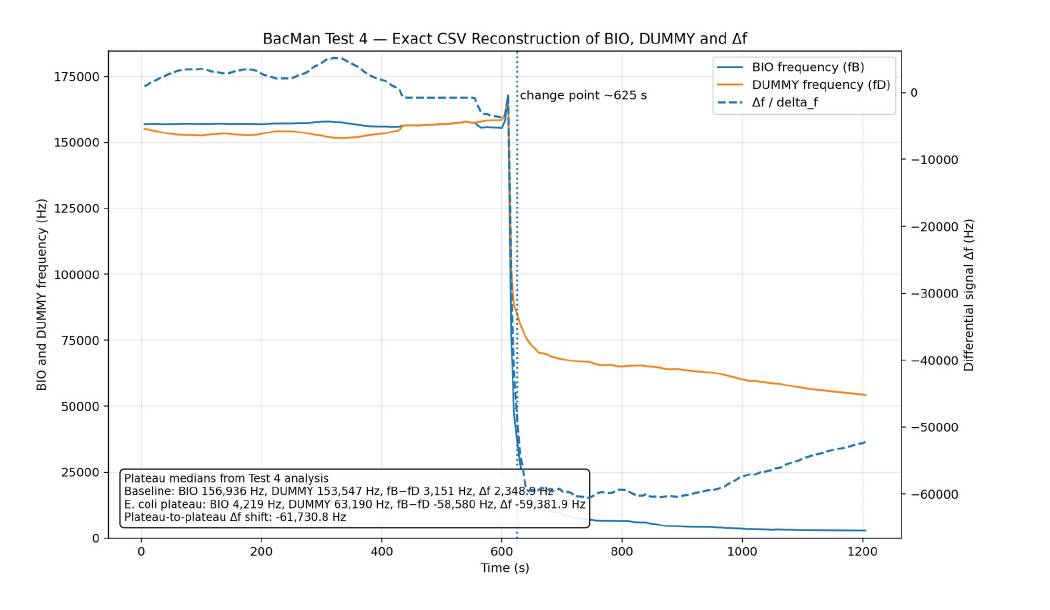
Absolute magnitude of the baseline-corrected differential frequency shift in BacMan Test 4 after exposure to E. coli.
Independent check: PalmSens4 measured a 62.5% drop in low-frequency IDE impedance in Test 4.
Phage-coated interdigitated electrodes were transferred from a sterile 2% sucrose reference medium to an E. coli suspension. BacMan measured the response continuously; PalmSens4 separately measured the sensor surface by impedance spectroscopy.
The result supports the detection principle under these laboratory conditions. It does not yet establish a field-water performance claim, clinical accuracy, specificity or a detection limit.
An active sensor carries the biological recognition layer. A passive dummy measures shared background changes. The reader subtracts the two frequency signals, suppressing common environmental drift and noise. A separate reference channel helps monitor the electronics.
A phage-coated gold IDE is the first demonstrated sensor surface. A different target requires a matching recognition layer and its own validation.
The dummy channel follows changes shared with the active channel. BIO minus DUMMY isolates the differential response with a baseline-based detection threshold.
Compact electronics count oscillator frequencies and apply a local baseline-based detection rule. The measurement needs no AI model, internet connection or cloud service.
This architecture is the platform: keep the digital measurement engine and change the recognition chemistry on the gold electrode for another suitable lock-and-key interaction. It can measure offline in remote settings. Each new application still needs its own biological validation and a suitable power, enclosure and sample workflow.
The prototype reader can be assembled with a soldering iron from roughly €30 of readily available electronic parts. Low-cost gold IDEs and local digital measurement could bring targeted biosensing into field and point-of-care workflows.
The approximately €30 component figure describes a hand-built reader prototype. A functioning test also requires a target-specific gold IDE, recognition coating, quality control and sample procedure. The below-€5 test cost is a scale-up target, not a verified production price.
The Stellenbosch result establishes a starting point for developing affordable, targeted biosensing in South Africa. The same architecture can be evaluated for new applications whenever an appropriate recognition mechanism can be built on the gold sensor surface.